Impact of GNLP on local NHS facilities

The NHS has provided comments on Regal’s GNLP application. The addition of a large number of new residents will stretch local facilities, particularly GP services. The NHS has requested a substantial contribution from Regal to cover the additional costs to local services, but Regal have refused this. It’s clear that the development would mean poorer health services for local residents, as well as inadequate facilities for those who would live at GNLP.
Regal’s assessment
In its planning application Regal stated that GNLP is within “a reasonable walking distance” of seven GP surgeries. Regal clearly thinks that most of the people visiting the surgeries will be fit and healthy hikers, because six of the surgeries are between 1.3km and 1.8km (0.8 to 1.1 miles) from GNLP. Given that most people who visit GP surgeries are unwell, and a large proportion are too elderly, too young, or otherwise unable to walk about one mile, this is somewhat puzzling.
Regal admits that most of the surgeries exceed the maximum of 1,800 patients per GP. It thus assesses that there would need to be an additional 1.82 “Full Time Equivalent” GPs. It also assesses that there would be a “Moderate Averse” impact on vulnerable groups.
In their brief review of health facilities, Regal’s consultants note that: “The nearest hospital with an Accident and Emergency (A&E) department is Finchley Memorial Hospital (…)”. They have clearly never been there (see below).
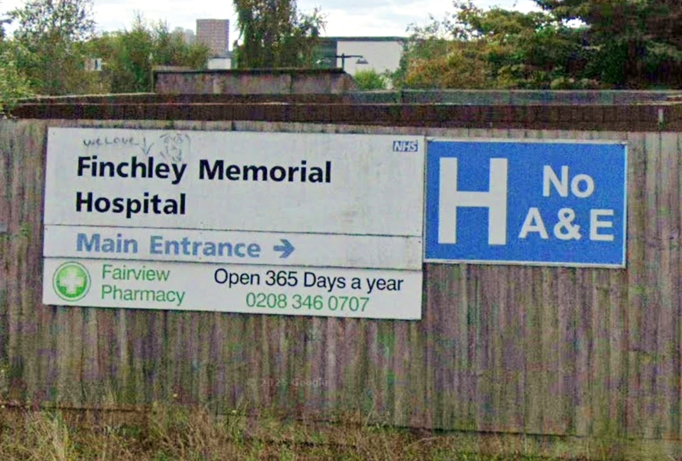
(NB: Such errors are frequent in planning consultants’ studies. This one is minor, but some seriously misrepresent the effect of a development on affected parties and the community. Council planners do not much care how many such errors an applicant makes. Problems may only arise for them when the errors affect the physical design or construction plans, leaving both the developer and the council looking foolish.)
NHS England’s comments and requirements
The NHS usually assesses how major developments will impact its capacity. It may then request a special contribution from the developer towards necessary investments. Some additional capacity may also be funded from the “Community Infrastructure Levy” (CIL) paid by developers to the council. CIL is designed to cover local infrastructure needs created by a development.
The NHS carried out an assessment of whether local GP practices can provide for the additional patients from GNLP. Significantly, the closest surgery to GNLP (Squires Lane – only 150 meters away) no longer includes GNLP in its catchment area, and would not accept patients from GNLP.
Without Squires Lane, the residents of GNLP would be poorly served because their nearest GP practice is be almost a mile away. This illustrates the relatively isolated location of GNLP for those without a car (supposedly around 80% of future residents) and why it is a poor location to house over 4,000 people without a lot more services.
This reduces practices available to GNLP to four. However, of these Cornwall House has relocated to Torrington Park, which the NHS rightly deems to be too far from GNLP. It will also be burdened by new development in the town centre (e.g. Lodge Lane, Homebase, Masterplan).
Wentworth Medical Practice (still a long way from the development) is assessed by the NHS as most suitable for GNLP. It is already operating above the 1,800 patients/GP benchmark. It does not seem to be coping well with its existing 18,285 patients as “portacabins are being used to address space limitations”. Of the other options, Woodlands is too small and perhaps Rosemary has other constraints.